Use Artifact Keeper with the DevGuard Dependency Proxy
Artifact Keeper is an open-source, self-hosted artifact registry. A Remote repository in Artifact Keeper caches a public registry. Put the DevGuard dependency proxy in front of it, and every package still passes your package rules and the malicious package check:
client → DevGuard → Artifact Keeper (Remote) → public registry
1. Create a Remote Repository
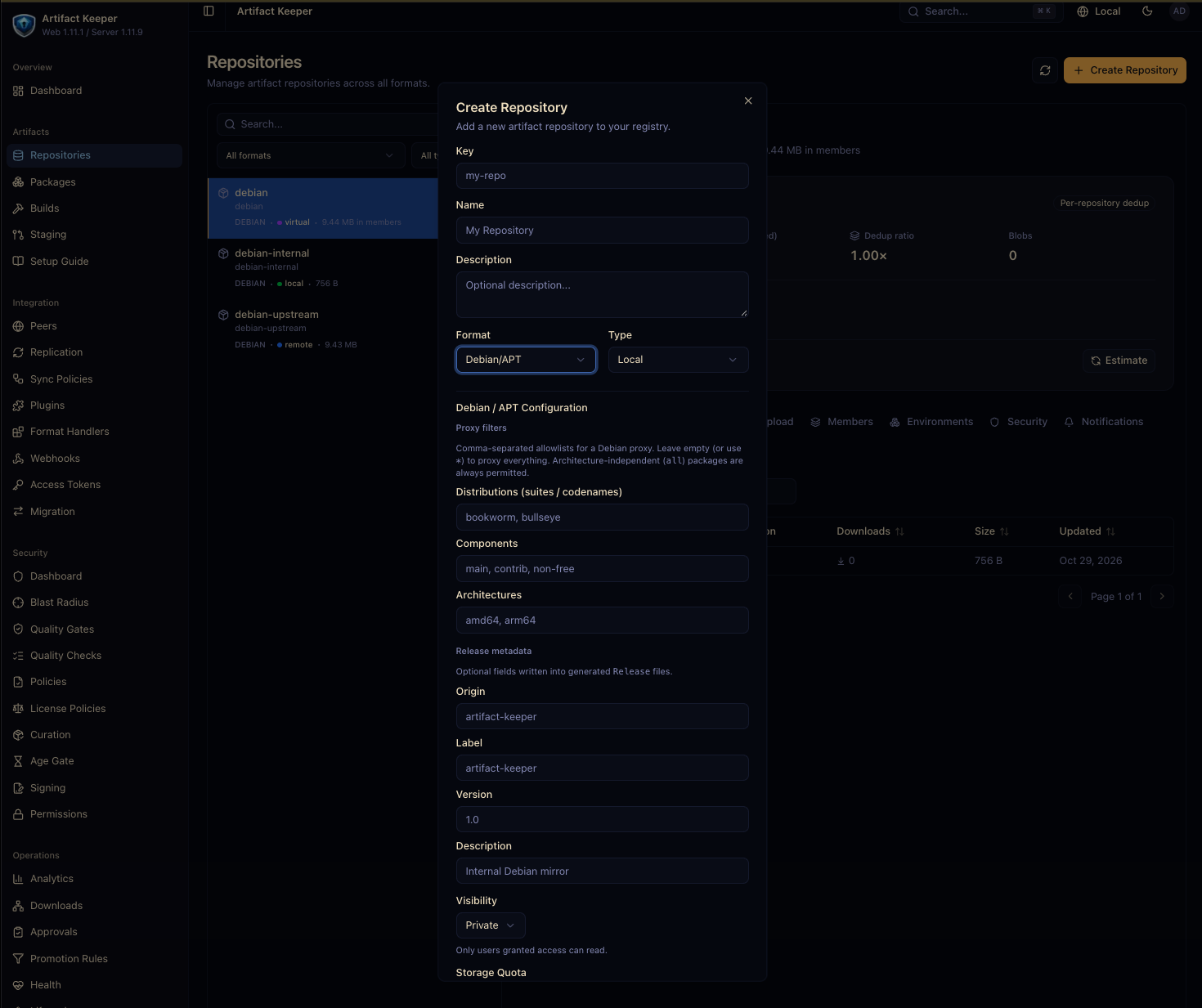
In Artifact Keeper, open Repositories → Create Repository, select the format, set the type to Remote and the visibility to Public. DevGuard does not send credentials to the registry.
| Ecosystem | Format | Upstream URL | Value for registries in DevGuard |
|---|---|---|---|
| npm | npm | https://registry.npmjs.org | https://<artifact-keeper>/npm/<key> |
| PyPI | PyPI | https://pypi.org | https://<artifact-keeper>/pypi/<key> |
| Go | Go | https://proxy.golang.org | https://<artifact-keeper>/go/<key> |
| Maven | Maven | https://repo1.maven.org/maven2 | https://<artifact-keeper>/maven/<key> |
| Composer | Composer | https://repo.packagist.org | https://<artifact-keeper>/composer/<key> |
| Debian | Debian/APT | http://deb.debian.org | https://<artifact-keeper>/debian/<key> |
2. Point DevGuard at Artifact Keeper
Add the repositories under registries in the Dependency Proxy settings of your organization, project or repository. Only list the ecosystems you want to route through Artifact Keeper:
Your clients keep using the DevGuard proxy URLs, nothing changes on their side.
Artifact Keeper must be reachable from the DevGuard backend over HTTPS and must not run on localhost. DevGuard blocks requests to loopback addresses, and it only downloads PyPI and Composer files over HTTPS.
Ecosystem Notes
- npm, PyPI, Composer: Artifact Keeper rewrites download URLs onto itself. DevGuard rewrites them back onto the proxy, so downloads and lock files point to DevGuard. Self-hosted DevGuard needs
DEPENDENCY_PROXY_BASE_URLset to its public URL for this. - Maven: Artifact Keeper sends no
Last-Modifiedheader. DevGuard reads the release time from Maven Central instead. Artifacts that do not exist there have no release time. - Debian:
- Use the root
http://deb.debian.orgas upstream, so that both thedebianand thedebian-securityarchive are reachable. - Release times come from the official Debian archive, see How Debian packages are handled.
- Blocked versions are replaced with older ones that DevGuard downloads directly from snapshot.debian.org, not through Artifact Keeper.
- Use the root
- Alpine: Not supported yet. The proxy passes the package index through unchanged and only blocks the download of disallowed versions. Clients can therefore see updates in the index that the proxy then rejects with
403 Forbidden.
Internal Packages
DevGuard accepts one registry per ecosystem, and a Virtual repository in Artifact Keeper does not merge the Debian package lists of its members. Serve internal packages from a Local repository and configure it in your package manager next to the DevGuard proxy, for example as a second apt source. Internal packages then bypass DevGuard.
If you route a Local repository through DevGuard instead, its packages have no known release time: Debian treats them as released now, Maven as unknown. A minimum release age rule blocks them, so add an allow rule such as pkg.name == "debian/mycompany-tool".